
Menu Engineering Was Built for 1995. Your Guests Live in 2025.

For decades, restaurant operators have relied on a simple formula to understand their menus: what sells, what it costs, and how much profit it brings in. Known as menu engineering, the system divides items into tidy categories—Stars, Dogs, Plowhorses, and Puzzles—based on two metrics: popularity and profitability. It offered something many operators wanted: structure. Decisions […]
The Problem with Cost-Plus Pricing
For much of the industry, restaurant pricing has followed a familiar, comfortable logic. A dish costs a certain amount to produce, so you apply a standard markup—two, maybe three times the base cost—and land on a price. It’s simple, defensible, and easy to apply across a menu. This model, known as cost-plus pricing, is still […]
Limited-Time Logic: Why Scarcity Still Sells

Why less can mean more—when the limits are real. Guests make decisions emotionally, not mathematically. And few emotions move faster than the fear of missing out. Scarcity plays directly into that urgency. A dish that might disappear feels more important. A cocktail that’s only available this week becomes more intriguing. A special that sells out […]
What Guests Feel Before They Order: The Power of Priming

There are things on your menu that guests will never consciously notice—but they’ll shape the entire experience. The way a section is labeled. The words you use to describe a dish. The order in which options appear. All of it speaks before the guest makes a decision. That’s priming. Priming is one of the most […]
Anchoring

How the first number on your menu sets the tone for every choice that follows. What’s the first price a guest sees on your menu? Whatever it is—whether it’s $9 or $95—that number just shaped the way they’ll interpret every price that comes next. This is the Anchoring Effect in action: a cognitive bias that […]
What Is Menu Engineering—and Why It’s No Longer Enough

In most restaurants, the menu isn’t just a list of offerings—it’s a map of decisions. Decisions about pricing, placement, inventory, and what kind of guest experience the business wants to create. And for the last few decades, one framework has guided many of those decisions: menu engineering. The model itself is straightforward. First introduced in […]
The Decoy Effect
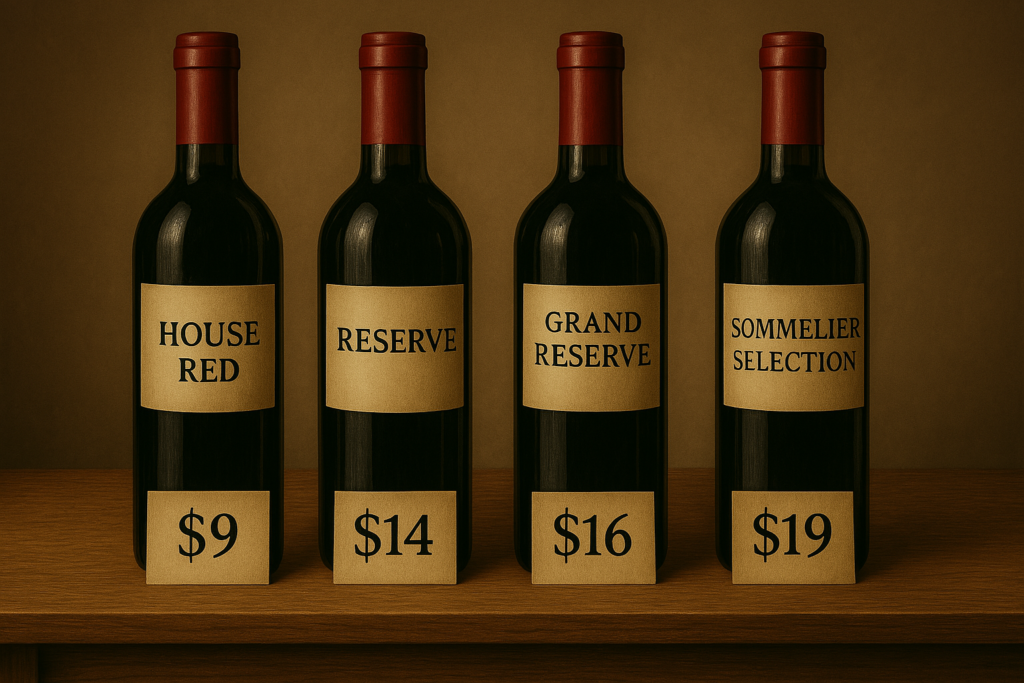
How to sell the right item by showing the wrong one. Not everything on your menu is meant to be chosen. Some items are there to make others look better. That’s the idea behind the Decoy Effect—an elegant principle from behavioral economics that shapes decision-making through context. First studied in the 1980s by marketing researchers […]
Designing Menus That Guests Don’t Realize They’re Reading

The behavioral science behind better decisions, higher checks, and why your guests never really choose alone. Most menus aren’t broken—they’re just not doing enough. They list the food, they follow the brand, and they check the boxes. But they rarely guide the guest experience. They don’t influence behavior. They don’t drive profitability in any deliberate […]
The Strategic Power Behind High-Performing Menus

Why a great menu doesn’t just show your food—it drives your business. In hospitality, it’s easy to overlook the menu. After all, it’s just a list. You print it, tape it to a clipboard, and maybe redesign it every few months when the brand gets an update or costs go up. Seasonality might kick in. […]
QSR

Speed Wins. But Profit Keeps the Doors Open. In QSR, time is tight and margins are tighter. MOM360° helps you spot what’s working, fix what’s not, and make every menu choice count—from layout flow to pricing psychology. We cut through clutter and complexity so your guests order faster, spend more, and leave happier. Behind the […]